
An Iranian’s Journey Home
An Iranian’s Journey Home
He Cycled 6,400 Kilometers to Stand at Iran’s Border. Here’s Why.
Looking Toward Iran
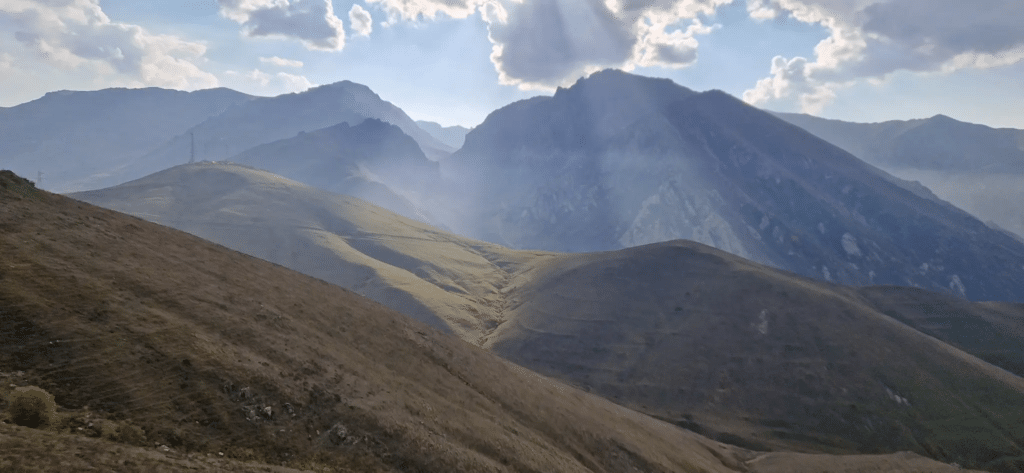
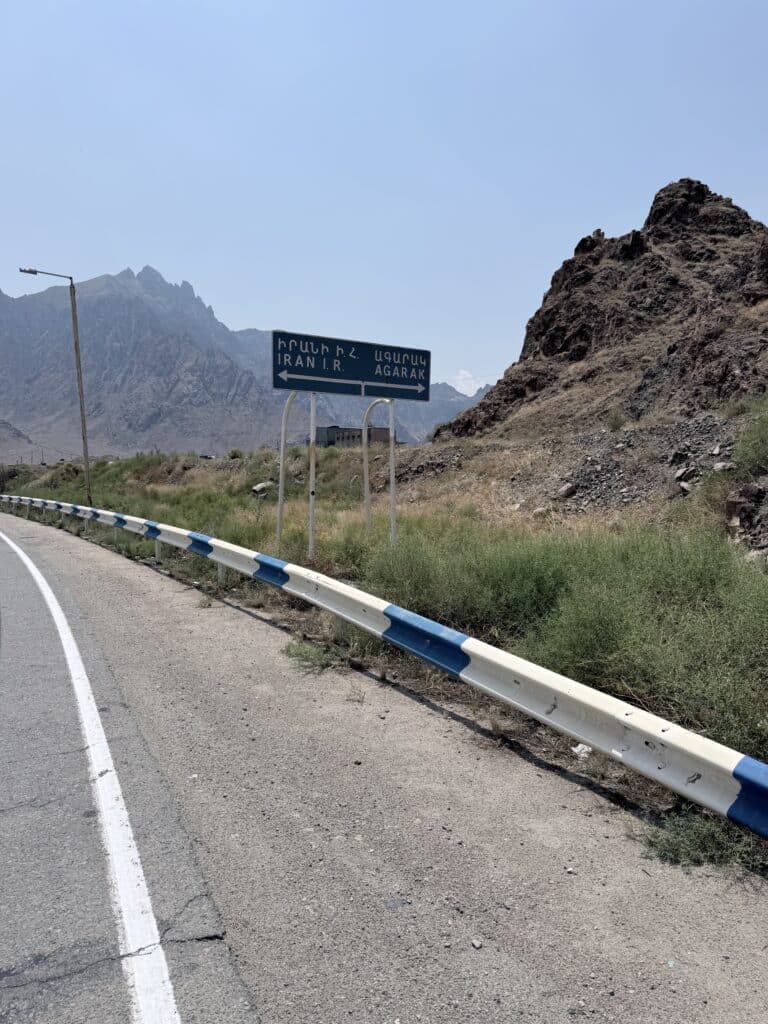
Rain drifted across the mountains as Arotin Babakhani climbed the final stretch of road toward Meghri, a small Armenian town overlooking the Iranian border. For fifty-seven days he had pedaled steadily east, crossing plains, forests and mountain ranges, sleeping in campsites and relying on little more than careful planning, determined perseverance and God’s daily provision. His bicycle had carried him through nine countries and more than 6,400 kilometers of Europe and western Asia. Now, with only the Arax River separating him from Iran, the journey was almost over.
Then the clouds began to lift. Across the valley, beyond the river and beneath the clearing sky, the familiar outline of the Iranian mountains slowly came into view.
For a moment, he simply stood and stared. “I was overwhelmed,” he says quietly. “I cried.”
He had imagined reaching this place hundreds of times over the previous seventeen years. He had planned routes, studied maps, trained his body and prepared his equipment.
He had often wondered what it would feel like to see home again. Not the home he had grown up in—his family had left Iran when he was a child—but the country that had never really left him.
I am so thankful that God brought me here. But at the same time, my heart is broken. I wish I could do more.
Beyond the mountains lay the country he had left as a child more than twenty-five years earlier. It is also home to millions of people who live under oppression and uncertainty, including believers who continue to follow Christ despite persecution, quietly gathering in house churches across Iran, discipling new Christians and sharing the hope of Jesus at great personal cost.
A 17-Year Calling
The thought first came almost seventeen years earlier.
While out cycling near his home in the Netherlands, Arotin sensed God placing an unexpected vision on his heart. One day, he would make a journey towards Iran. Not because he wanted to test his endurance or break a record, but because of a God-given passion to support the courageous Christians of Iran.
The vision was clear. The timing was not. Life moved on. Arotin married Noora. Together they built a home and welcomed two daughters. Work, church and family filled the years, yet the conviction never disappeared. Instead, it quietly began to take shape in the background, waiting.
“If God gives you a vision,” Arotin says, “He also knows when it should happen.”
Eventually, that time came.
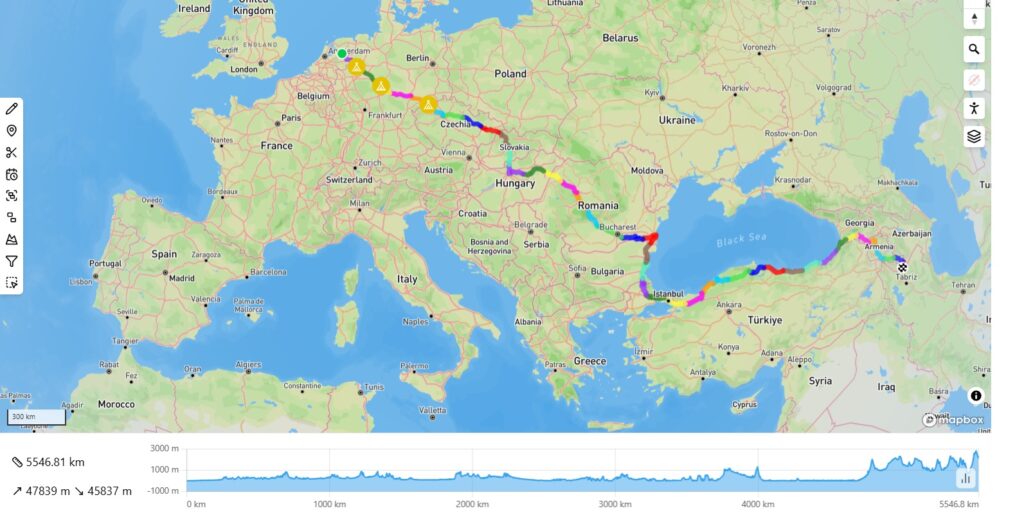
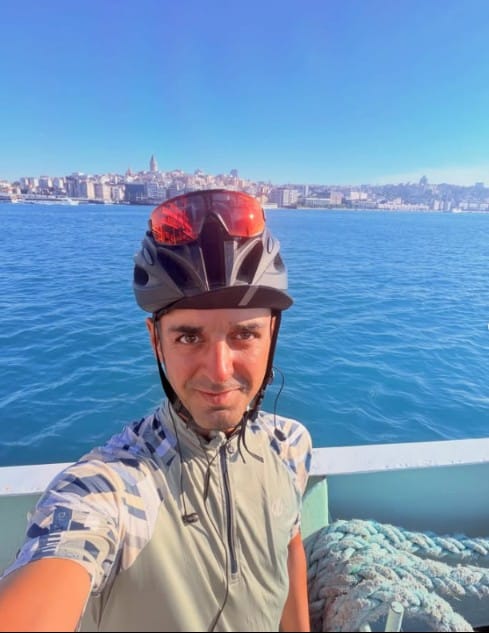
On May 9 this year, after months of preparation, prayer and planning, he wheeled a heavily loaded touring bicycle out of his driveway in Staphorst and pointed it east.
Friends waved goodbye. His family watched him leave. Ahead lay nearly two months on a completely unknown road. No support vehicle. No traveling companion.
Just one man, one bicycle and a dream that had lived in his heart for almost two decades.
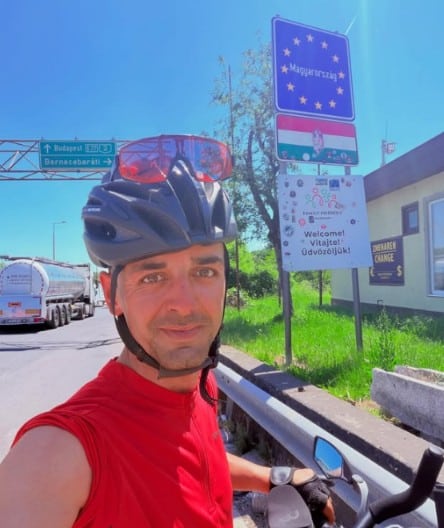
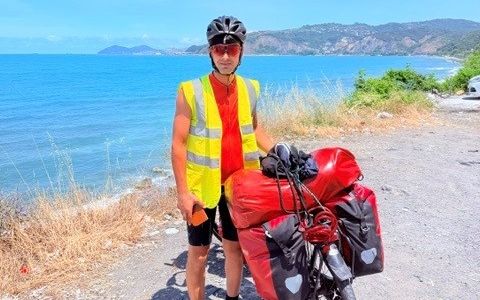
His route would take him from the Netherlands through Germany, the Czech Republic, Slovakia, Hungary, Romania, Bulgaria, Turkey and Georgia before finally reaching Armenia, where he would stand at the border with Iran. Originally planned as a 5,500-kilometer journey, the expedition grew to more than 6,400 kilometers as weather, road closures and unavoidable detours added hundreds of extra kilometers along the way.
Time after time, people told him the journey would be impossible to complete alone.
For Arotin, it was an act of obedience.
“Sometimes God prepares us for years before asking us to take the first step.”
Why Cycle 6,400 Kilometers?
Over the next fifty-seven days, Arotin would climb mountain passes, ride through driving rain, push his loaded sixty-kilogram bicycle for almost forty kilometers when roads became impassable, and navigate unfamiliar countries where he knew neither the language nor the landscape.
But long before the first pedal turned, he had decided that if the journey became merely an athletic achievement, he would have missed the point.
Every kilometer was intended to point beyond itself. Toward a people. Toward a Church. Toward millions of Iranians who don’t have the freedom to practice their faith as openly as many Christians elsewhere take for granted.
Whenever things became difficult, I reminded myself why I was doing this.
That purpose transformed the journey. Pain was no longer simply something to endure. It became something to offer. Every climb became an act of prayer. Every difficult day became another opportunity to remember believers whose daily lives require a perseverance far greater than his own.
For a glimpse into life as an underground believer in Iran
Watch Arotin explain the heart behind his journey before he embarked.
Preparing for the Journey
Months before leaving the Netherlands, Arotin had planned almost every practical detail.
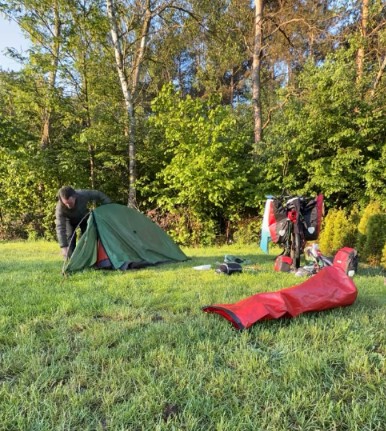
He studied maps late into the evening, searching for routes that passed through villages rather than following Europe’s popular long-distance cycleways. The decision added hundreds of kilometers to the overall journey, but it also meant he would be able to find enough food to sustain him for the long haul, refill water bottles and locate campsites or small guesthouses at the end of each day.
“It was important to think about sustainability,” he explains. “Some endurance cyclists lose close to a kilogram a day.” Careful planning made an enormous difference. Despite cycling more than 6,400 kilometers, Arotin lost only two or three kilograms during the entire journey.
Learning to Trust God Daily
The first week was harder than Arotin expected.
Months of preparation had given him confidence that he could cover the distance. He had trained consistently, refined his equipment and planned his route with meticulous care. Yet no amount of preparation could condition his body for the relentless rhythm of riding day after day while carrying everything he needed on his bicycle. Within days his ankles had swollen so badly that his cycling shoes barely fit Rain swept across exposed roads, temperatures dropped unexpectedly, and every morning he woke knowing that another hundred or more kilometers awaited him before he could rest again.
The journey was tough. Each morning required faith. Each day brought unfamiliar roads. Road closures forced detours. Mountain weather changed without warning. Some campsites were closed, while others appeared unexpectedly just when he needed them most. Each evening required fresh decisions.
“God doesn’t usually show us the whole journey.”
“The Bible says not to worry about tomorrow. I think I understood that in a new way,” Arotin reflects as he remembers the Israelites gathering manna in the wilderness—God gave them enough for one day at a time.
“I realized I couldn’t control tomorrow. God only asks us to trust Him today.”
Day after day, he was given just what he needed: enough strength to reach the next town, enough food for the next stage, enough encouragement to keep moving, and the next night’s accommodation.
Whenever he found himself looking too far ahead, the distance became overwhelming. When he focused instead on the next hill, the next village or the next conversation, the road became manageable again.
It was during those early days that Arotin started praying the same simple prayer each morning, before packing his tent and climbing back onto the bicycle: “Lord, let me bring a smile to at least one person today.” Looking back, he smiles at the simplicity of it. He could have prayed for stronger legs, favorable weather or easier roads.
Arotin had expected the journey to be a lonely one. In many ways, it was. For around forty days, he cycled alone, spending long hours with little more than the road, his thoughts and his prayers.
God’s faithful provision came, quietly and consistently over fifty-seven consecutive days.
Unexpected Protection
One afternoon, while riding through forested countryside, Arotin mentioned part of his route to another long-distance cyclist.
The man’s face changed immediately.
“You rode through there?”
“Yes.”
“Alone?”
Arotin nodded.
“We never use that road,” the cyclist replied. “There are bears.”
Only then did Arotin remember noticing large footprints pressed into the soft ground beside the road. At the time he had thought little of them, assuming they belonged to cattle or horses. Now he realized he had spent hours cycling through an area that local riders deliberately avoided.
He laughs as he tells the story.
“I didn’t know.”
There is no bravado in the way he remembers it. If anything, the story became another reminder that much of God’s protection passes unnoticed. Had he known about the bears beforehand, he might have spent the day anxious, scanning every tree line.
It became another lesson in hindsight. Sometimes we only recognize God’s care after the moment has passed.
God’s Provision on the Road
There was one moment when I prayed, and before I had even finished praying, someone stopped to help.
His bicycle had developed a mechanical problem. Alone and far from anywhere familiar, he found himself facing the possibility that the journey might stall before it had really gathered momentum. The route ahead depended on a working bicycle, yet the solution was beyond his control.
“I said, ‘Lord, please send someone with a truck.'”
The prayer had barely left his lips when a vehicle appeared. A truck pulled over, the driver offered to help, and before long Arotin’s bicycle was safely loaded. Looking back, he is still amazed at how quickly everything happened.
“It was immediate.”
For him, the moment was memorable not simply because someone stopped, but because he knew God was there with him.
Not every answer came so immediately. More often, God’s provision looked wonderfully ordinary.
Sometimes it was a police officer who went out of his way to transport his bicycle after another mechanical problem. At other times, it was someone pointing him toward a campsite he would never have found on his own, a family inviting him to share a meal, fresh cherries handed to him at the roadside or a few simple words of encouragement.
These were people whose names he may never know, but whose generosity became woven into the journey. Each played a small part in helping him reach the mountains where, weeks later, he would stand looking across the valley toward Iran.
At one campsite in Romania, the owner struck up a conversation after noticing Arotin’s heavily loaded bicycle. Curious about the journey, he asked where he was travelling and why. As Arotin explained the purpose behind the expedition and his concern for Christians in Iran, the conversation deepened. When it came time to leave the following morning, the campsite owner refused to accept payment. It was a small gesture in practical terms, yet it stayed with Arotin long after.
By themselves, none of those moments seemed extraordinary. But they were powerful evidence of God’s love and faithfulness.
Get Trusted Updates from Iran
Receive monthly updates. Stay informed. Pray with clarity. Stand with the people of Iran.
When the Road Became Too Steep
There were days when the journey slowed almost to a standstill.
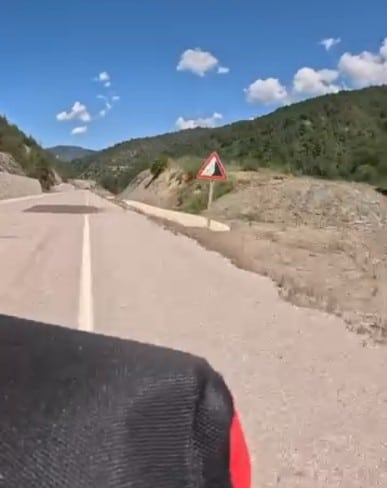
One of the hardest came when the road climbed so steeply that cycling was no longer possible. With his bicycle and equipment weighing around sixty kilograms, Arotin climbed off the saddle and began pushing uphill instead. What looked manageable on a map became an exhausting test of endurance, each step demanding as much determination as the last.
By the end of the day, he had walked nearly thirty-eight kilometers.
The progress was painfully slow. The bicycle that had carried him so faithfully across Europe had become something he now had to drag behind him, meter by meter. Every incline seemed to reveal another beyond it, and the destination felt no closer than it had that morning.
There was little to do except keep walking.
Looking back, Arotin doesn’t dwell on the frustration as much as the perseverance it required. The journey, he realized, was not defined by spectacular moments but by ordinary decisions repeated hundreds of times. Keep moving. Stop when necessary. Begin again. Eventually, even the longest climb came to an end.
“You pray differently at moments like that,” he says with a smile.
Those were the moments that revealed what the journey had really become. Not simply a test of endurance, but a daily lesson in dependence.
“I had such peace,” Arotin reflects. “I knew God was with me.”
Finding God in the Wilderness
The weather often seemed determined to test his resolve. Heavy rain soaked his clothes and equipment. Thunderstorms rolled across the mountains, forcing him to seek shelter until it was safe to continue. On other days, strong headwinds turned even gentle roads into an exhausting struggle, demanding constant effort for very little reward.
None of it was dramatic enough to make headlines. Yet day after day, those small hardships accumulated. Wet clothes took time to dry. Fatigue settled quietly into his legs, making each new day slightly harder than the last.
Most of the journey was spent alone.
There were long stretches without mobile reception. No conversations. No music. No podcasts. Just the sound of his bicycle, unfamiliar roads stretching toward the horizon and hours of uninterrupted silence.
Those quiet roads became places of honesty, worship and complete dependence.
“I have experienced God’s presence throughout my life,” he says, “but never as deeply as I did during this journey.”
He pauses, trying to find words to describe it.
I felt like Adam. There was nobody else. It was just me and God.
Removed from the noise and routines of everyday life, he found himself standing before God with a vulnerability he had never experienced before. There was no audience, no performance, no distraction—only Creator and creation.
It became the deepest sense of God’s presence he had ever known.
Meeting Iranian Christians in Turkey
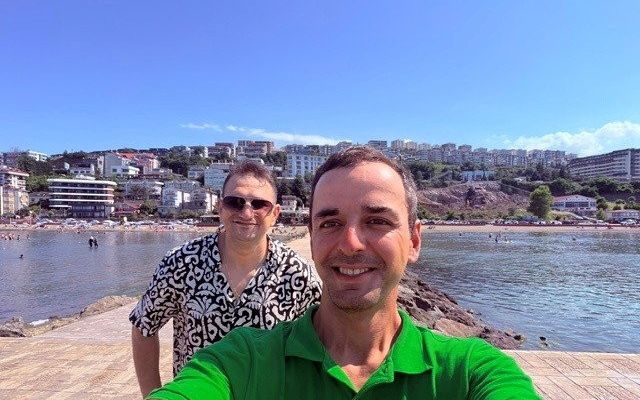
By the time Arotin reached the Turkish city of Trabzon, he had spent weeks on the road.
There, he visited a small church, eager to worship before continuing east. After weeks of traveling alone, stepping into a room filled with fellow believers felt like arriving among family.
The congregation welcomed him warmly. Although many of the people he met had lived very different lives and spoke different languages, the barriers that often separate strangers seemed far less significant inside the church. They prayed together, shared fellowship and encouraged one another, united by a faith that reached beyond national borders.
Among those he met were Iranian Christians who had fled their homeland because of persecution. They were forced to leave behind homes, careers, extended families and familiar communities. They had to start again as outsiders in a completely new environment, placing an uncertain future in God’s hands.
Meeting them also deepened Arotin’s connection to Christians in Iran, who quietly gather in homes because of the risk of exposure and punishment. He thought about believers who have no way of escape and continue following Christ despite significant risk.
Having been born in Iran himself, the country had always remained deeply personal. Although his family left when he was young, he had never stopped caring about the people who still lived there or about the growing number who have chosen to follow Christ despite the pressures they face.
Read about our work with refugees and the persecuted church
The Family Sharing the Journey
Each morning, as Arotin climbed onto his bicycle, his wife, Noora, and their two daughters followed his progress from the Netherlands. While he packed his tent and studied the day’s route, they checked for updates, watched his location move steadily east and prayed for his safety.
The journey took Arotin away from home for nearly two months. For fifty-seven days, Noora managed family life without him, caring for their daughters while following his progress, praying for him and encouraging him from hundreds of kilometers away.
Only a short time after leaving the Netherlands, Arotin received news that one of his daughters had broken her arm.
Being so far away was one of the hardest moments of the journey. He couldn’t drive home. He couldn’t help. He couldn’t hold her.
“I felt burdened,” he says. “My wife had to manage everything, and I couldn’t be there.”
It was a sacrifice the whole family was making together. While Arotin continued cycling across Europe, Noora quietly carried the responsibilities they would normally share.
Yet even from a distance, his daughters became one of his greatest sources of encouragement.
His eldest daughter regularly reminded him that she believed in him. Sometimes she would simply say, “Dad, you can do it.” Other times she urged him to keep going when the day’s goal seemed impossible.
“Those words gave me strength,” he says.
During those conversations, Arotin found himself sharing more than stories about mountains, campsites and border crossings.
“Thankfulness became one of the biggest lessons God taught me,” he says. “Every day is another opportunity to discover God’s faithfulness.”
Over nearly two months on the road, he became convinced that gratitude changes how we travel through difficult seasons.
Thankfulness connects with God’s heart. Worship is a way of thinking; it’s a lifestyle that I want to grow in and teach my children.
The journey was never easy. There were days when the mountains seemed endless, his body ached and the destination still felt impossibly far away.
Yet again and again he discovered that gratitude changed how he traveled, even when it didn’t change the road ahead.
“As long as you stay thankful and continue worshiping God—especially during the difficult times—God surprises us with the most beautiful blessings.”
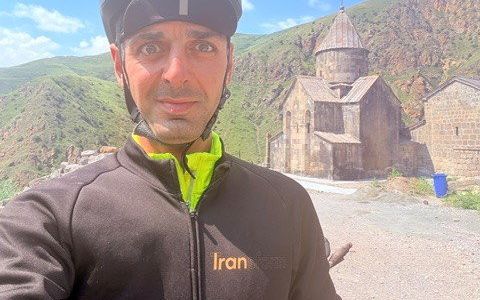
When Arotin finally reached the church in Armenia, Noora and their two daughters were waiting for him. Members of the local Armenian church welcomed them with flowers and cake to celebrate the end of the journey.
After nearly two months apart, their reunion became one of the most joyful moments of the entire adventure.
“I just want to spend every second with my family,” he says.
Arotin hopes his daughters remember far more than the distance he cycled. He hopes they remember the God who proved Himself faithful every single day—a God who can be trusted, who is present, and who never leaves His children to walk alone.
Please Don’t Forget Iran
Seventeen years after God first placed the journey on his heart, Arotin reached the Iranian border.
But the reason he cycled 6,400 kilometers has not changed. The Church in Iran still needs the prayers of believers around the world.
Pray that the people of Iran would know the freedom found in Christ; that those who continue to suffer would know God’s presence in every trial; and that the courageous Church in Iran would continue to be strengthened by the same faithful God who walked with Arotin through every mountain pass, every lonely road and every unexpected provision.
I needed faith and perseverance during this journey. But Iranian Christians need that even more.
Please remember Iran. Pray for the Church. Stand with those who continue to follow Christ, whatever the cost.

Donate Today


